




1. Monitoring Background
As an important component of transportation, bridges are receiving increasing attention for their safety, durability, and normal functionality with the development of China's transportation industry. China is a major bridge country. According to the latest data from the Ministry of Transport, as of the end of 2024, there are approximately 1.1083 million highway bridges (excluding municipal bridges) in China. There are many factors that affect bridges, such as human factors, long-term overloading of vehicles, material degradation, natural disasters, etc., which lead to various diseases such as reduced bearing capacity and structural damage of existing bridges. At the same time, there is a lack of timely and effective management and maintenance. If the damage cannot be detected and repaired in a timely manner, it can affect driving safety and shorten the service life of the bridge, and in severe cases, lead to sudden damage and collapse of the bridge. Therefore, it is particularly urgent to establish an intelligent online monitoring system for bridges to timely detect damage to bridge structures.
II. System Overview
freesun Technology has many years of experience in bridge monitoring, and has established an intelligent, information-based, and automated bridge online monitoring system that can comprehensively grasp the safety status of bridge construction and operation, playing a huge role in bridge construction, daily maintenance, management, and emergency response. Based on the cloud computing service center, it can accommodate all bridge monitoring systems within the region, forming a regional bridge health monitoring platform to achieve unified monitoring and management of all bridge structures within the region.
III. Main Monitoring Contents
1. Geometric line monitoring: arch rib line monitoring, main beam deflection monitoring, axis offset measurement;
2. Stress and strain monitoring: beam strain, bridge tower strain, main arch strain, bridge pier strain, etc;
3. Cable/tension monitoring: tie rod tension, suspension rod tension, anchor cable stress, etc;
4. Environmental monitoring: wind speed and direction, temperature and humidity, rainfall, visibility, corrosion
7. Deviation monitoring: tower top deviation, arch foot deviation, arch crown deviation;
8. Vibration monitoring: beam vibration, arch vibration, bridge tower vibration, suspension rod (cable) vibration;
9. Load monitoring: dynamic weighing system;
10. Tilt monitoring: bridge tower tilt, bridge pier tilt, beam tilt;
11. Other monitoring: crack monitoring, fatigue monitoring, ship collision, cameras.
IV. Monitoring Diagram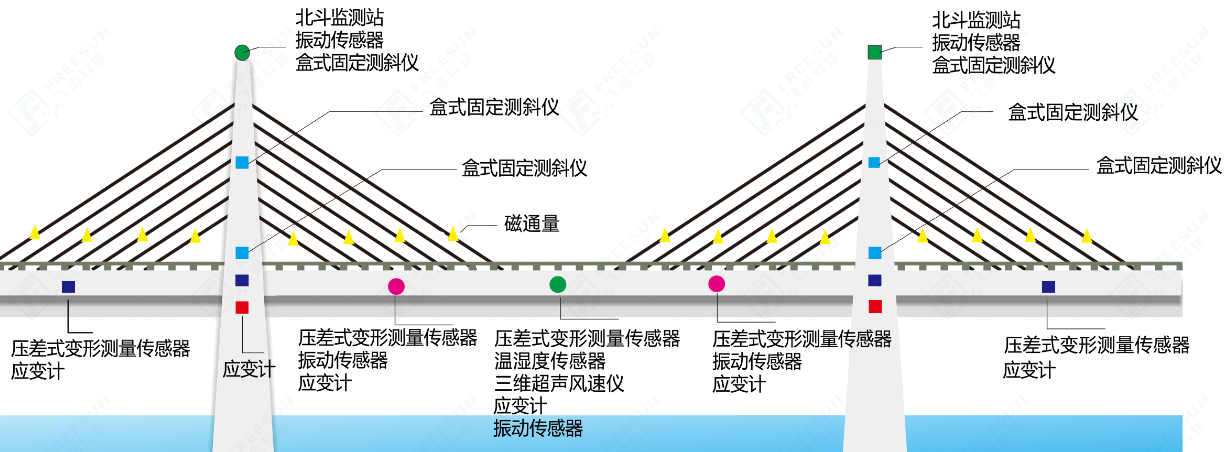
V. List of Monitoring Projects
| Monitoring item | Device name | Monitoring item | Device name |
| Stress and strain | Strain gauge | Expansion joint | Linear displacement sensor |
| Cable force | Magnetic flux sensor/accelerometer/anchor cable sensor | Temperature and humidity | Temperature and humidity sensor |
| Vibration acceleration | accelerometer | Vehicle load | Dynamic weighing system |
| Deformation displacement | GNSS、 Box type fixed inclinometer | Bridge deck video | Infrared network high-speed ball machine |
| Settlement/deflection | Static level | Wind speed and direction | Wind speed and direction indicator |
| Cracks | Crack gauge | Earthquake | accelerometer |
VI. Monitoring Basis
(1) Technical Specification for Monitoring of Highway Bridge Structures (JT/T 1037-2022);
(2) Technical Code for Monitoring of Building and Bridge Structures (GB50982-2014);
(3) Design Standards for Structural Health Monitoring Systems (CECS333-2012);
(4) Technical Specification for Construction of Highway Bridges and Culverts (JTG/TF50-2011);
(5) Technical Condition Evaluation Standards for Highway Bridges (JTG/T H21-2011);
(6) Code for Deformation Measurement of Buildings (JGJ8-2016);
(7) Bridge Engineering Inspection Manual, People's Communications Press, 2010;
(8) Testing and Inspection Technology for Bridge and Culvert Engineering ", published by People's Communications Press in 2004;
(9) Design Code for Integrated Cabling System Engineering (GB 50311-2016);
(10) Quality Inspection and Evaluation Standards for Highway Engineering (JTG F80/1-2017);
(11) Design Specification for Highway Reinforced Concrete and Prestressed Concrete Bridges and Culverts (JTG 3362-2018)
(12) Technical Standards for Highway Engineering (JTG B01-2014);
(13) Regulations for Testing and Evaluating the Bearing Capacity of Highway Bridges (JTG/T J21-2011);
(14) Engineering Surveying Standards (GB 50026-2020);
(15) Engineering Vibration Measurement Instruments and Testing Techniques, China Metrology Press, 2001;
(16) Specification for Precision Engineering Surveying (GB/T 15314-2024);
(17) Design Code for Lightning Protection of Buildings (GB 50057-2010);
(18) Code for Acceptance of Integrated Cabling System Engineering (GB/T 50312-2016);
(19) Reliability and Maintainability Management of Computer Software (GB/T14394-2008);
(20) Computer Site Security Requirements (GB/T9361-2011);
(20) Code for Construction and Acceptance of Low Voltage Electrical Equipment Installation Engineering (GB 50254-2014);
(21) "Guidelines for the Application of Spatiotemporal Big Data in Monitoring the Structure of Highway Long Bridges", Ministry of Transport, 2024;
(22) Technical Specification for Maintenance and Replacement of Highway Bridge Bearings and Expansion Devices (JTG/T 5532-2023);
7. Implement Functions
1. Full life cycle monitoring: Implement full life cycle monitoring of bridges, including relevant content during construction and operation periods, such as strain, temperature, linearity during construction, strain, linearity, vibration, environment, stress during operation, etc., store and analyze data, and display GIS+BIM or GIS+4D models comprehensively to grasp the full life cycle status of bridges and provide decision-making basis for management;
2. Automatic report push: In addition to real-time display of monitoring results, the system will automatically generate corresponding daily reports, which support one click download. Once the data exceeds the threshold, timely warning and notification can be given to relevant units to take corresponding measures in a timely manner;
3. Grading warning: Set different warning levels according to requirements. When data is abnormal, automatic warning information will be triggered according to the settings, including platform push, SMS, and email notifications to the corresponding person;
4. Accumulate bridge status data: provide necessary decision-making basis for long-term operation, maintenance, repair, and reinforcement of bridges, and provide a basis for evaluating the safety status of bridges after emergencies occur. At the same time, use AI algorithms to predict the structural response and development of bridges in the future time period;
5. Provide reference basis: Verify the design and construction theory and construction technology of the bridge, in order to improve the relevant design and construction technical regulations and ensure the safe use of the bridge.